


DC/DC Converters for Agriculture and Agricultural Machinery
DC/DC converters for agricultural applications connect conventional 12 V or 24 V vehicle electrical systems with modern electrical loads and 48 V systems on agricultural machinery and implements. They enable high electrical power directly on the machine while reliably compensating for fluctuating supply voltages. At the same time, they must operate reliably under demanding conditions such as heat, vibration, dirt, water and aggressive environmental influences.
Our rugged DC/DC converters combine high power density with full PU potting, aluminium housings, CC/CV control and adaptable electrical characteristics – for ploughs, seeders, fertiliser spreaders and other electrified agricultural systems.
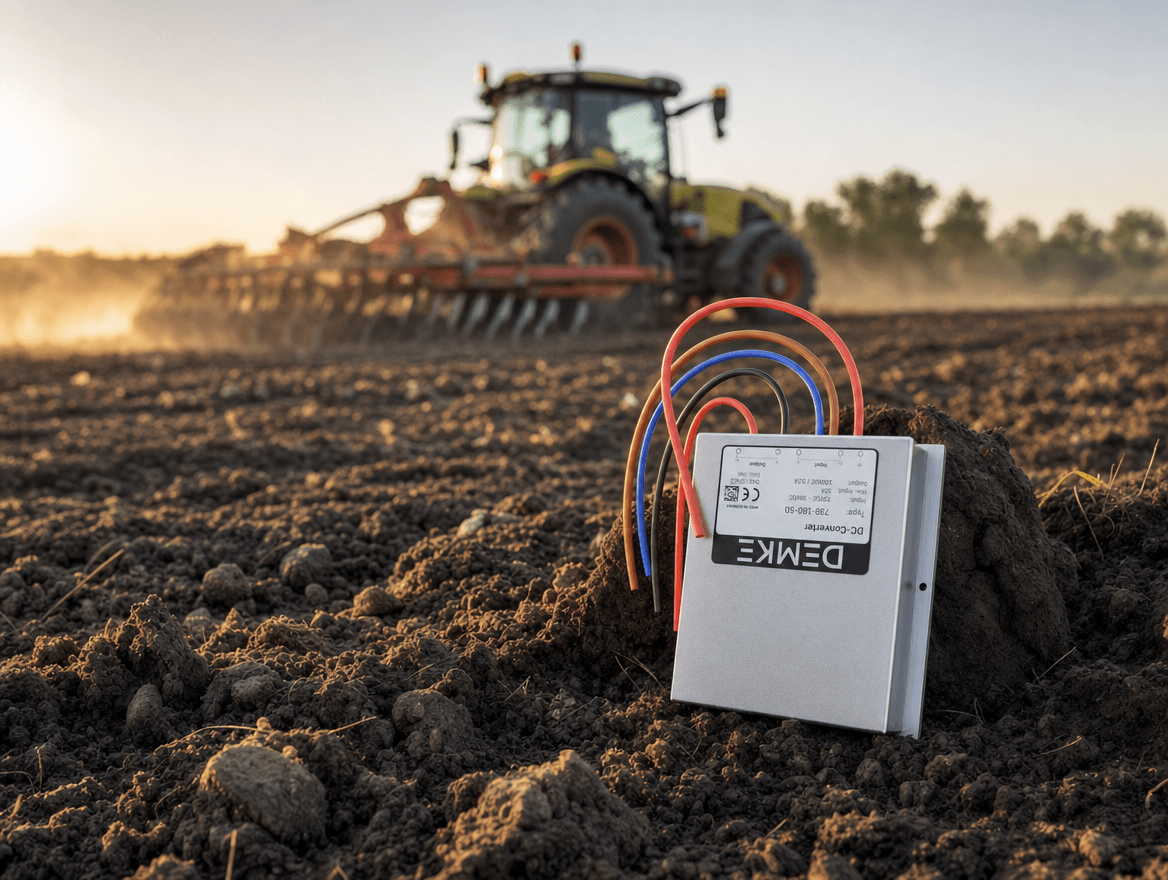
High Power Under Harsh Operating Conditions
Electronics on agricultural machinery operate under very different conditions from electronics installed in a control cabinet. Vibration and mechanical shock are part of everyday operation. Dust, mud, water, intensive cleaning and high temperatures during long working days in summer add further challenges.
Fertiliser is a particular challenge. In combination with moisture, it can create an aggressive environment and place heavy stress on materials, connectors and mechanical components. In applications like these, it is therefore not enough to select a DC/DC converter based only on input and output voltage.
At the same time, agricultural machinery and implements are becoming increasingly electrified. Electrical actuators, pumps, drives, sensors and control systems require more electrical power and, in some cases, additional voltage levels such as 48 V.
The DC/DC converter therefore becomes the interface between the existing electrical system of the tractor and the new electrical functions on the implement. It must handle fluctuating input voltages, high currents and the demanding conditions found in real agricultural operation.
Our rugged converter platforms combine aluminium housings, full PU potting, wide temperature ranges and tested resistance to shock and vibration.
From 12 V to 48 V: Power Supply Directly on a Plough
We are currently supporting a major agricultural machinery manufacturer in the development of a high-performance 48 V power supply for a plough. Electrical energy is supplied by the tractor’s 12 V electrical system and transferred to the implement through appropriately sized cables. The DC/DC converter is installed directly on the plough, where it generates the required 48 V supply for the machine’s electrical functions.
The basic concept:
12 V tractor electrical system → DC/DC converter on the plough → 48 V DC bus → electrical loads
The customer is also providing an installation compartment or enclosure for the converter. Among other things, it reduces direct sunlight exposure and provides additional protection against fertiliser and contamination. The converter itself must nevertheless withstand vibration, mechanical shock, high temperatures and the stresses of long operating periods.
The project is currently in the prototype and development phase. The basic concept, converter topology and key functions are already defined. The final input voltage range and required continuous power are now being adapted to the machine together with the customer.
Low Input Voltage, High Output Power
One of the main challenges is the combination of a low input voltage in the range of a 12 V vehicle electrical system with a powerful 48 V output supply.
A vehicle electrical system does not provide a constant laboratory voltage. The battery, alternator or generator, cable lengths and other loads all influence the voltage that actually reaches the converter. Under high load, the voltage can drop significantly.
Demke already has solutions and experience with this converter topology at low input voltages down to around 10 V and with 48 V output systems. Higher power levels have also already been implemented using the same underlying topology. For the current agricultural project, the final values are now being specifically adapted to the application.
At several hundred watts, very high currents can already occur on the 12 V side. Cable cross-sections, connectors, cable lengths and voltage drops are therefore just as important as the DC/DC converter itself.
Very Short Power Peaks up to 1.2 kW
In addition to normal operating power, the application can experience very short power peaks. In the current development project, peaks of up to 1.2 kW for less than one second are being considered.
Designing the complete DC/DC stage permanently for this short maximum power level is not necessarily the most sensible solution. Instead, an external energy storage device on the 48 V side can provide the additional energy required during the short load peak.
The concept is:
DC/DC converter for continuous power + energy storage for peak power
During normal operation, the converter supplies the 48 V system and charges the energy storage device at the same time. If significantly more power is required for a short period, the buffer supplies the additional energy. The DC/DC converter then recharges it afterwards.
External Energy Buffer with CC/CV Control
The customer therefore specifically asked us whether an external buffer could be used together with the DC/DC converter. This is already possible with the existing converter concept. Our suitable converters use CC/CV control as standard. A capacitor or supercapacitor can therefore be charged in a controlled manner and automatically recharged after a load peak.
In constant-current mode, the converter limits the charging current. As the voltage rises, the control transitions into constant-voltage mode and maintains the required output voltage.
No fundamental modifications to the converter are required for this basic concept. The required size of the energy storage device depends on the actual load profile, peak power, duration of the load peak, permitted voltage drop and frequency of the peaks.
Parallel Operation or Energy Storage?
Suitable Demke DC/DC converters can also be operated in parallel to provide higher continuous power.
This is useful when the additional power is required continuously or for longer periods. For a power peak lasting less than one second, however, a local energy storage device may be the more attractive solution.
The DC/DC converter can then be sized for the actual continuous power requirement, while the buffer supplies the short-term peak power.
Generator on the 48 V DC Bus
Another special feature of the current project is a generator on the 48 V side.
This means that the DC bus does not consist exclusively of loads. Possible generator operating conditions and energy flows must therefore also be considered during system design.
A suitably designed buffer can provide additional energy for short periods and can also temporarily absorb energy generated on the 48 V system. How longer periods of generated energy are handled depends on the specific generator, the permitted voltage range and the overall energy concept of the machine.
This point in particular shows why demanding mobile applications should not be considered only at the level of the individual DC/DC converter, but as a complete 48 V energy system.
Built for Real Agricultural Conditions
The converter is installed directly on the implement and is therefore exposed to the mechanical and environmental conditions of the machine.
Our rugged DC/DC converters use aluminium housings and electronics that are fully potted in polyurethane. The PCB and electronic components are completely embedded in the potting material. This provides additional protection against moisture and contamination, as well as high mechanical stability against shock and vibration.
One particularly interesting lesson from the current project is: Fertiliser attacks almost everything.
Fertilisers, especially in combination with moisture, can create a highly aggressive environment. For this reason, not only the converter itself but also housing surfaces, cables, connectors, mounting components and the overall installation conditions must be considered together.
A high IP protection rating does not automatically mean chemical resistance to fertiliser. However, the full PU potting inside the converter provides an additional protective barrier around the sensitive electronics.
The 729-48-SD currently used in the project is tested according to ISO 20653 with IP6KX and IPX9K. It is also tested for vibration according toIEC 60068-2-6and for mechanical shock according to IEC 60068-2-27.
The application is also thermally demanding. Agricultural machinery can operate for many hours at high ambient temperatures during the season. The additional installation enclosure provides protection from direct sunlight, but heat dissipation must still be taken into account. Our rugged converter platforms are therefore designed for wide temperature ranges and high thermal loads.
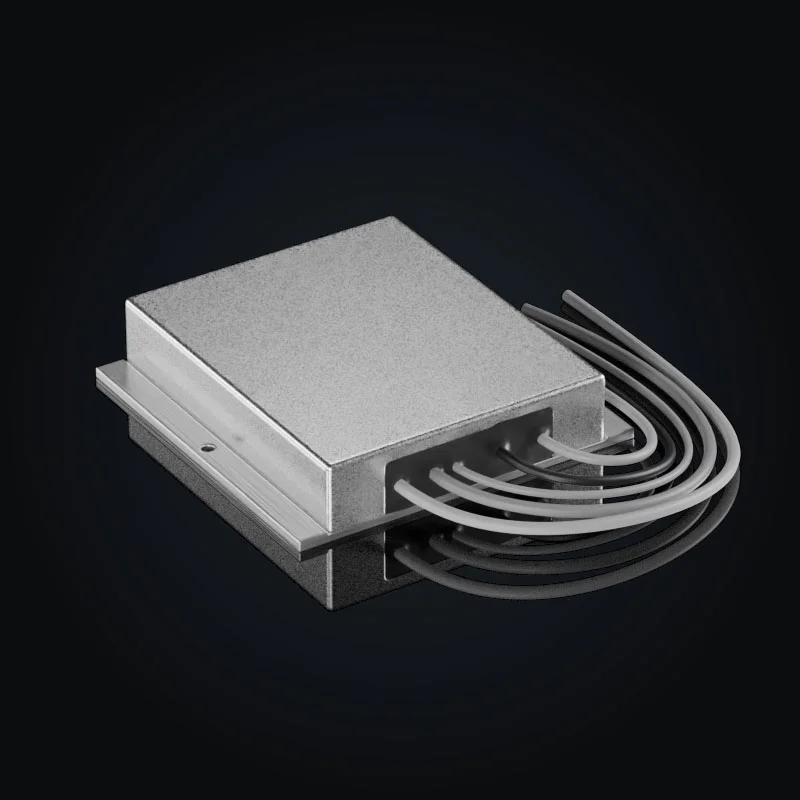
The Right DC/DC Converter for Your Agricultural Application
Whether it is a plough, seeder, fertiliser spreader, autonomous agricultural vehicle or another electrified implement, the right DC/DC solution depends on more than just input and output voltage.
We consider the complete application: the vehicle electrical system and cabling, continuous and peak power, load profile, temperature, shock and vibration, protection requirements and possible energy storage.
Depending on the project, an existing DC/DC converter can be used, an existing platform can be adapted, or a custom DC/DC solution can be developed.
FAQs
Have questions? We have answers!
Can a DC/DC converter generate a stable 48 V from 12 V?
Yes. A step-up DC/DC converter can increase a low input voltage to a higher output voltage. The key factors are the actual input voltage range, the required output power and the resulting input current.
Why is 48 V interesting for agricultural implements?
For the same power level, a higher voltage reduces the required current on the load side. This is particularly useful for powerful electrical actuators, pumps and drives. The existing 12 V or 24 V vehicle electrical system can still be used as the energy source.
How can very short power peaks be handled?
An external capacitor or supercapacitor can provide additional energy for short periods. The DC/DC converter supplies the continuous power and recharges the energy storage device after the load peak.
Can Demke DC/DC converters charge supercapacitors?
Suitable Demke DC/DC converters use CC/CV control and can charge large capacitive loads in a controlled manner. The 729-48-SD, for example, is specified with CC/CV control and unlimited capacitive load.
Can multiple DC/DC converters be operated in parallel?
Yes. Suitable converters can be operated in parallel to increase the available continuous power. For very short power peaks, however, an external energy storage device may be the more efficient solution.
Why is full PU potting useful for agricultural applications?
With full potting, the PCB and electronic components are completely embedded in polyurethane. This provides the electronics with additional protection against moisture, contamination and mechanical stress.
Does IPX9K mean that a DC/DC converter is resistant to fertiliser?
No. IP protection ratings describe protection against water and solid foreign objects. They do not provide general proof of chemical resistance to fertiliser. The housing, potting compound, cables, connectors and installation conditions must therefore be considered as a complete system.
Are Demke DC/DC converters tested for shock and vibration?
Our DC/DC converters are tested according to IEC 60068-2-6 for vibration and IEC 60068-2-27 for mechanical shock (type testing).
Can DC/DC converters be customised for a specific agricultural machine?
Yes. Depending on the project, parameters such as the input voltage range, output voltage, power, cabling, connections and other electrical or mechanical characteristics can be adapted.
More questions? Check our FAQ or glossary for further information, or contact us.