


DC/DC converters for e-mobility and vehicle technology: onboard power systems, charging converters and E-mark approval
DC/DC converters in electric vehicles supply the 12 V vehicle electrical system from the traction network, charge battery systems and keep the supply voltage stable when the vehicle voltage changes. Especially in commercial vehicles, the requirements go far beyond simple voltage conversion. Different 24 V, 48 V and 60 V vehicle platforms should ideally be covered with only a few converter variants, while EMC requirements must still be met in the complete vehicle. Our converters therefore cover input voltage ranges from 17 to 70 VDC with one device platform, achieve up to 96% efficiency without power derating and can be approved for road use according to UNECE Regulation R10 on request.
Variants, EMC and an onboard power system that allows no margin for error
Vehicle onboard power systems are electrically harsh environments. During start-up, the voltage drops, while alternators and traction inverters generate electrical interference and switched inductive loads cause transients. In addition, there are vibration, shock, dust, moisture and temperatures ranging from desert summers to Arctic winters.
Two problems are more significant than the technical challenges alone:
Wide variety of options. Commercial vehicle fleets are rarely homogeneous: manufacturers working with 24 V, 48 V and 60 V platforms need a separate narrow-input-range converter for each one – each with its own part number, approval, spare parts inventory and procurement process. These costs are not reflected in the purchase price itself, but in the organisation behind it.
EMC compliance for the complete vehicle.
In an electric vehicle, the DC/DC converter operates alongside power electronics that switch high currents in the kilohertz range. However, electromagnetic compatibility must be demonstrated for the complete vehicle. If the vehicle fails the test, troubleshooting begins: identify the source, make modifications and test again – potentially adding weeks to the project schedule shortly before series production. A component that already comes with this compliance reduces troubleshooting effort because one potential source of interference has already been tested.
One converter for 24 V, 48 V and 60 V onboard power systems – electric vehicles in urban applications
A manufacturer of electric cleaning and municipal vehicles for urban environments uses our 162E-13.8-ON to supply the vehicle’s 12 V system from the traction power system – including the onboard power outlets used to connect additional equipment during operation.
This is more electrically demanding than it may sound. In a fully electric vehicle, there is no alternator: the DC/DC converter takes over its role and is the only source for recharging the 12 V system. The 12 V battery acts as a buffer and is charged solely by the converter. The onboard power outlet is also the only point in the vehicle where the manufacturer cannot control what is connected – work lights, telematics, chargers or control devices. The converter must therefore be able to continuously deliver its full power and remain short-circuit protected, even if a faulty auxiliary device is connected. With 13.8 VDC at up to 20.0 A and 275 W, there is sufficient reserve.
The converter operates over an input range of 17 to 70 VDC. This means one device can cover 24 V, 48 V and 60 V vehicle electrical systems. The manufacturer manages one part number instead of three variants, completes one approval process instead of three and keeps one spare part in stock instead of three.
The 13.8 V is not a random value: it corresponds to the float charging voltage of a lead-acid onboard battery. The converter therefore not only supplies the 12 V loads but also keeps the onboard battery charged – eliminating the need for a second component.
With an efficiency of up to 96%, little heat is generated, which is dissipated through the housing. Modern semiconductors and direct heat dissipation enable high power density in a compact, highly integrated design – without fans or moving parts.
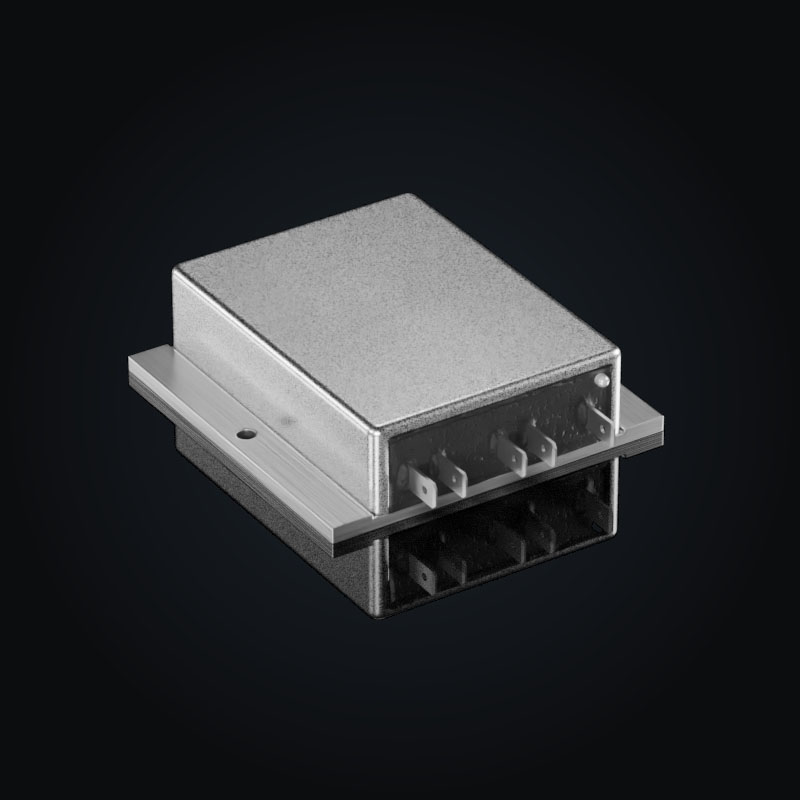
Truck-mounted work platform: battery charging from the alternator with E-mark approval according to UNECE Regulation No. 10
A manufacturer of truck-mounted aerial work platforms powers the lifting platform from its own battery system, independently of the vehicle electrical system. The task of our 729-57-ON is to recharge this battery system from the alternator while driving.
The converter generates a charging voltage of 57 VDC at up to 450 W from the vehicle’s onboard power system. Its input range of 12 to 32 VDC covers both 12 V systems and truck alternators with an output voltage of 27.6 V. At the work site, the platform then operates from the charged battery.
CC/CV charging profile. The 729-57-ON is a true battery charging converter, not just a power supply: it charges with constant current (CC) until the final charging voltage is reached, then switches to the constant-voltage phase (CV), during which the charging current gradually decreases. This is essential for fully and gently charging a lithium-ion battery system and for preventing the converter from entering overload protection when connected to a deeply discharged battery.
The system architecture offers a practical advantage: the converter does not need to provide the peak power required by the aerial work platform, but only needs to replace the energy used. The battery handles the high, short-term loads during lifting. This allows the charging converter to be significantly smaller than a direct power supply would need to be. With dimensions of 130 × 130 × 28 mm, it also fits into tight installation spaces.
D+ compatibility. The D+ signal from the alternator indicates that the engine is running. The converter only charges when the engine is running, so the vehicle’s starter battery is not drained while the work platform is in operation. Charging can also be enabled through the integrated ON control signal from the vehicle control system.
Galvanic isolation. It electrically isolates the work platform’s battery system from the vehicle’s onboard power system. This prevents unwanted current flow through shared ground paths and prevents the work platform’s control system from affecting the vehicle’s electronics.
Operational safety. The converter is continuously protected against no-load operation and short circuits. If the power is not sufficient, multiple units can be operated in parallel.
E-mark approval according to UNECE Regulation No. 10: tested, not just claimed
The 729-57-ON is approved for use in road vehicles in accordance with UNECE Regulation No. 10 on electromagnetic compatibility in vehicles, Revision 05, under approval mark E13. The regulation applies in all contracting parties to the UNECE Agreement and therefore extends well beyond the EU.
Notably, the approval was granted twice – for both customised versions of the charging converter, the 729-57-SD and the 729-57-ON. The EMC result is therefore not a one-off result from a single sample, but a repeatable result of the design, even with customised modifications.
The extent to which the requirements are met is shown by the conducted emissions test over the entire range from 30 MHz to 1 GHz: Both broadband and narrowband emissions passed, with the measured values consistently around 30 dB below the limits specified by the regulation – equivalent to approximately one-thirtieth of the permitted field strength.
For the bodybuilder, this means that its own EMC verification for this component is no longer required, while the margin to the limit remains available for the rest of the vehicle.

48 V onboard power system for zero-emission heavy-duty transport
A manufacturer of heavy-duty transport systems uses our 757UH-48-SD in fully electric trucks and autonomous transport vehicles – commercial vehicles in continuous operation, where downtime directly costs money. With an input range of 19 to 110 VDC, the converter provides a stable 48 V supply with up to 15.0 A for control systems, sensors and auxiliary loads. The wide input range makes it independent of the vehicle’s specific traction voltage.
In a battery-electric vehicle, every power loss counts twice: it directly reduces range and generates heat that must be dissipated in the tightly packed installation space between the drive components. The same applies here: if the power of a single unit is not sufficient, multiple units can be operated in parallel.
DC/DC converters for your vehicle project
Vehicle applications differ in terms of onboard voltage, power, battery system, charging function, installation space, EMC and environmental conditions. We review your application and determine whether a standard product is suitable, an existing platform can be adapted or a custom development is required.
FAQs
Have questions? We have answers!
What requirements do electric and commercial vehicles place on DC/DC converters?
DC/DC converters must handle widely fluctuating onboard voltages and reliably supply control systems, sensors and auxiliary loads with stable voltages. At the same time, they must withstand transients, vibration, temperature changes and high EMC requirements. For vehicle platforms with different onboard voltages, a wide input voltage range is also an advantage.
Can a DC/DC converter cover different 24 V, 48 V and 60 V vehicle platforms?
Yes. A wide-input converter designed for this purpose can cover several vehicle platforms with the same device. Our 162E-13.8-ON, for example, handles input voltages from 17 to 70 VDC and can therefore be used in 24 V, 48 V and 60 V vehicle electrical systems.
Why are 12 V onboard power systems still needed in electric vehicles?
Electric vehicles also require a low-voltage system for control systems, sensors and numerous auxiliary loads. Since there is no conventional alternator, the DC/DC converter supplies this 12 V system from the traction power system and can also keep the onboard battery charged.
Can a DC/DC converter charge the onboard battery while driving?
Yes. With a suitable charging profile, a DC/DC converter can charge the onboard battery in a controlled manner during operation. For example, one of our charging converters charges with constant current until the final charging voltage is reached; the control then switches to the constant-voltage phase.
What does approval under UNECE Regulation No. 10 mean for a DC/DC converter?
UNECE Regulation No. 10 defines requirements for the electromagnetic compatibility of electrical and electronic components in vehicles. A DC/DC converter approved accordingly has passed the required tests and therefore comes with documented EMC compliance for use in vehicles.
Why is high efficiency particularly important for electric commercial vehicles?
Every power loss draws energy from the battery system and is also converted into heat. High efficiency therefore preserves the available energy and reduces heat generation – particularly important at high power levels and in applications with limited installation space.
Why is galvanic isolation useful in vehicle applications?
Galvanic isolation electrically separates different circuits from each other. In the truck-mounted work platform, for example, it separates the platform’s battery system from the vehicle’s onboard power system. This prevents shared ground paths and unwanted current flows and reduces interference with the vehicle’s electronics.
More questions? Check our FAQ or glossary for further information, or contact us.