


DC/DC converters for aerospace
DC/DC converters for aerospace applications reliably supply sensors, cameras, communication systems, control units and safety-relevant functions with stable voltages. DEMKE develops compact and robust power supply solutions for applications where installation space, weight, efficiency and operational reliability are critical. Applications range from unmanned aerial systems to space re-entry capsules.
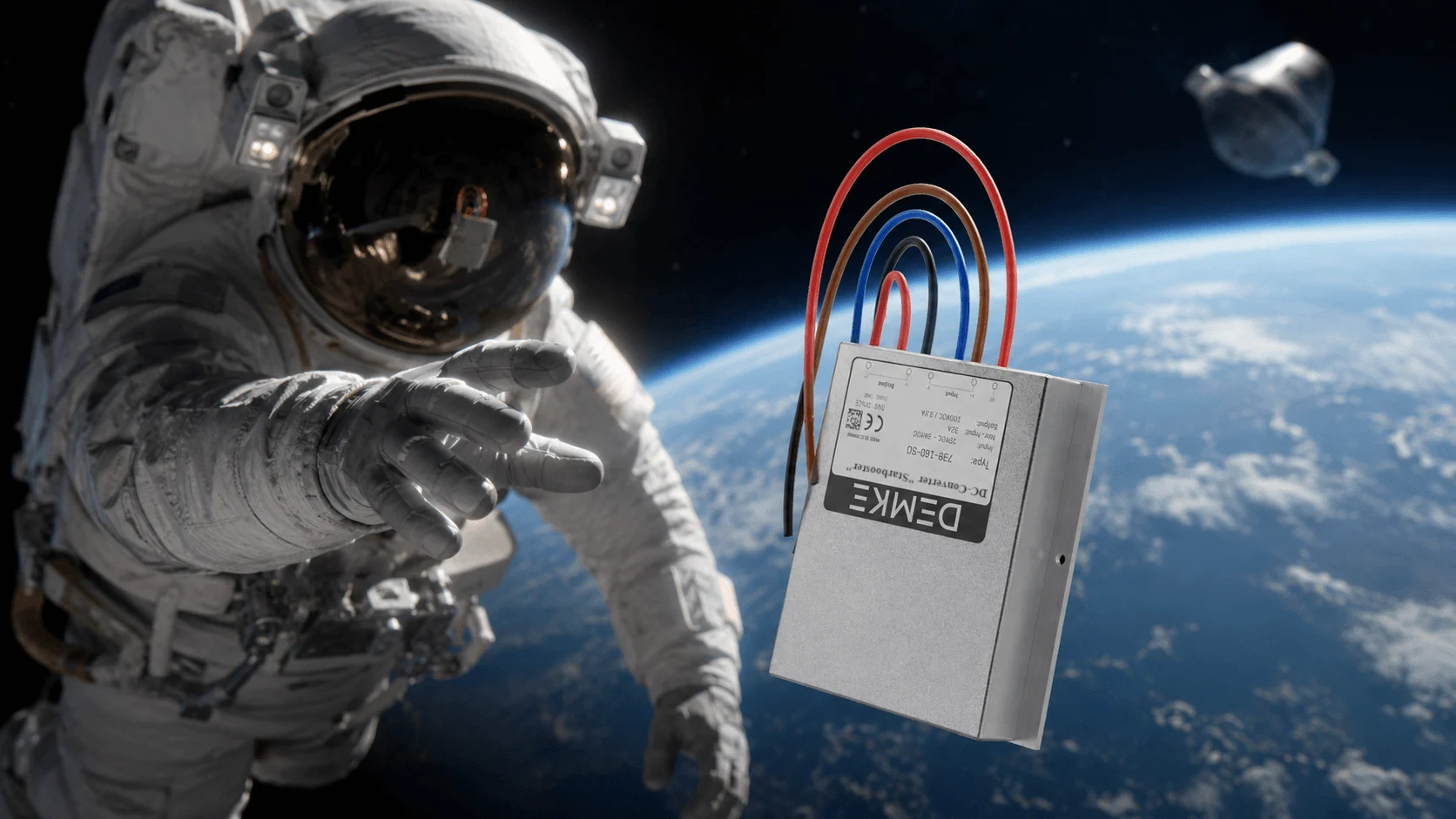
Reliable power supply under extreme conditions
Electrical systems in aerospace applications must operate under conditions that go far beyond those of typical industrial applications. Limited installation space, strict weight requirements, fluctuating battery voltages, high mechanical loads and extreme environmental conditions place high demands on the power supply.
During a rocket launch, electronics are exposed to severe vibration and shock. Unmanned aerial systems can be exposed to moisture, salt water and large temperature variations. In space applications, the power supply must also operate reliably under vacuum conditions.
Our DC/DC converters combine compact designs with high efficiency, robust aluminium housings and fully encapsulated electronics. Depending on the application, the input voltage range, output voltage, galvanic isolation, connections and mechanical design are adapted to the specific requirements.
Compact DC/DC converter for an unmanned aerial rescue system
A customer is developing an unmanned vertical take-off and landing system for search and rescue operations. The aircraft is designed, among other applications, to use a thermal imaging camera to search for missing persons over the North Sea.
Within the system, sensors, communication modules and camera units must be reliably supplied with stable voltage. At the same time, installation space and weight capacity are limited.
In addition, the power supply must withstand the environmental conditions over the sea. These include moisture, salt-laden air, temperature variations and mechanical stresses during flight operations.
For this application, the 145-24-SD DC/DC converter is used. Its input voltage range from 26 to 100 VDC provides a stable 24 VDC supply for the onboard electronics even when the battery voltage changes. With dimensions of only 77 × 52 × 19 mm and a weight of 165 g, it can also be integrated into very compact aircraft.
The converter achieves an efficiency of up to 95%. Its fully encapsulated design protects the electronics against vibration, moisture and other environmental conditions.
The combination of compact size, low weight and robust design allows the 145-24-SD to provide the required 24 VDC supply without taking up unnecessary space in the aircraft.
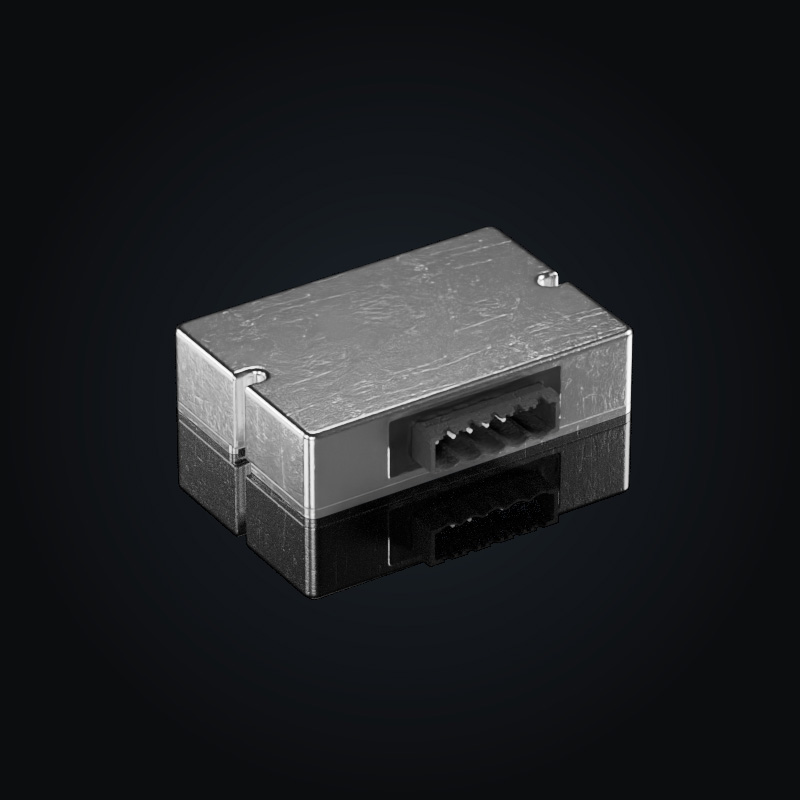
Galvanically isolated DC/DC converter for a re-entry capsule: The Sky Is Not the Limit 🚀
A space company is developing re-entry capsules that can safely return scientific experiments and cargo from space to Earth.
The capsules enable research under microgravity conditions, including biological and materials science experiments that are analysed on Earth after the mission.
For re-entry and the subsequent landing, a reliable power supply is required for the braking and parachute system. The energy is supplied by a battery. One connected function requires a galvanically isolated output voltage of 160 VDC.
A converter from the 739 series serves as the technical basis and has been adapted to the project-specific requirements. The DC/DC converter generates the high voltage required to activate the parachute system.
Mechanical stress during rocket launch
During launch, the DC/DC converter is exposed to severe vibration and shock. Electrical connections and electronic components must withstand these stresses without affecting the operation of the power supply.
The polyurethane encapsulation secures and protects the electronics inside the housing. This increases resistance to mechanical stresses during launch, flight and re-entry.
Operation under vacuum conditions
In space, the usual conditions for heat dissipation and convection are absent. Materials and encapsulation compounds must therefore be suitable for the intended vacuum environment and must not affect the operation of adjacent systems.
The mechanical and thermal design of the converter was therefore adapted to the operating conditions of the re-entry capsule.
The customised DC/DC converter provides the required voltage for the parachute system, supporting a key function for the safe return of the capsule and its scientific payload.
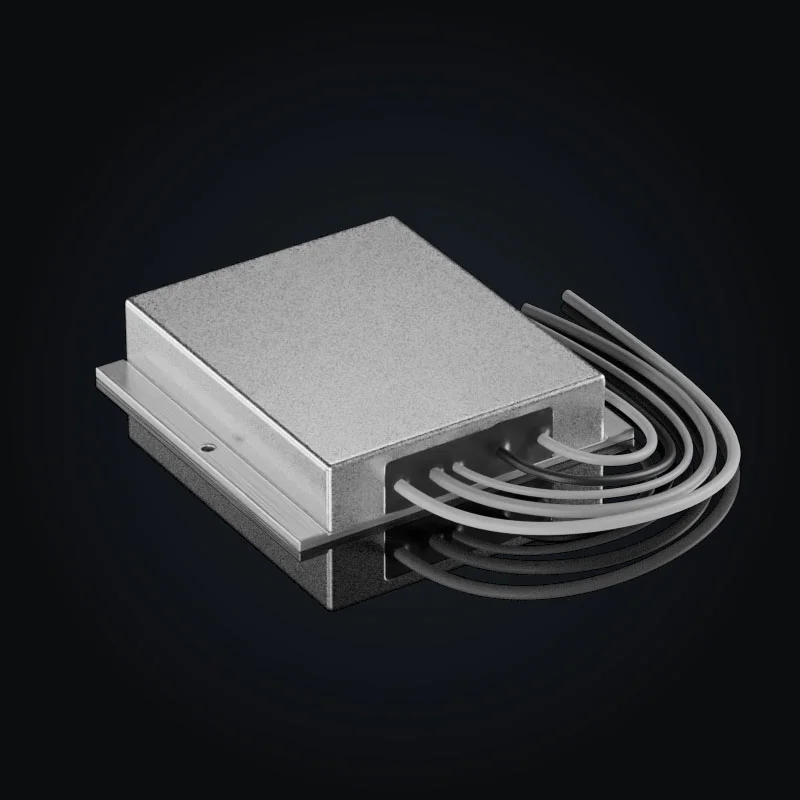
Custom DC/DC converter for autonomous passenger transport
A fully custom power supply was developed for an innovative aerospace project involving autonomous passenger transport systems.
The existing standard products could not fully meet the required electrical, mechanical and documentation requirements. A new converter solution was therefore designed based on the customer’s specific requirements specification.
The development included the electrical design, mechanical integration, selection of suitable materials, coordination of the interfaces and preparation of the required development and product documentation.
Due to the aerospace-specific requirements, the project was carried out in close collaboration with the customer. Requirements, verification documentation and design decisions were continuously coordinated before the first prototypes were manufactured and delivered.
This resulted in a power supply solution specifically tailored to the electrical architecture, available installation space and requirements of the future aerospace system.
DC/DC converters for your aerospace project
Every aerospace application has different requirements for input voltage, output voltage, power, weight, installation space, galvanic isolation and environmental conditions. We review whether an existing DC/DC converter is suitable, whether an existing platform can be adapted or whether a custom development is the best solution.
FAQs
Have questions? We have answers!
Why are DC/DC converters suitable for aerospace applications?
DC/DC converters provide stable supply voltages for sensors, cameras, communication systems and control units from fluctuating input voltages. In aerospace applications, compact design, low weight, high efficiency and robust mechanical construction are also essential.
Why is galvanic isolation important in aerospace applications?
Galvanic isolation electrically separates the input and output circuits. This allows different electrical potentials to be isolated from each other and sensitive or safety-relevant systems to be reliably supplied with power.
How do DC/DC converters withstand vibration and shock during a rocket launch?
The mechanical design, robust housings and fully encapsulated electronics increase resistance to vibration and shock. For project-specific solutions, the mechanical design is adapted to the requirements of the specific application.
Can DC/DC converters be used in a vacuum?
Operation in a vacuum requires an appropriately adapted thermal and mechanical design. Since there is no convective heat dissipation in a vacuum, the housing, materials and encapsulation, among other factors, must be suitable for the intended operating conditions.
Why is a wide input voltage range important for unmanned aerial systems?
Battery voltages vary depending on the state of charge and load. A DC/DC converter with a wide input voltage range can handle these fluctuations while still supplying the onboard electronics with a stable output voltage.
Are custom DC/DC converters available for aerospace applications?
Yes. The input voltage range, output voltage, galvanic isolation, connections, as well as the mechanical and thermal design can be adapted to the specific requirements of each project. Special contractual requirements apply to aerospace applications.
More questions? Check our FAQ or glossary for further information, or contact us.